
Climbing Techniques: Master Movement to Climb Smarter, Not Harder
Great climbers don’t muscle their way up a wall—they climb with intention, using precise techniques to solve the unique challenges of each route. If you want to elevate your climbing, focus on refining your technique and fluidity of movement. The most effective way to improve is simple: climb as often as possible.
Better technique starts with understanding the fundamentals of body movement and balance. Once you grasp these core principles, you can fine-tune the small details that make every move feel controlled and effortless.
The value of solid technique cannot be overstated. When you prioritize skill over strength, moves begin to feel natural, and you’ll glide up routes that once seemed out of reach. Below are the essential ideas to master:
- How to use your feet effectively
- How to stay balanced on the wall
- How to climb with greater efficiency
Using Your Feet: The Foundation of Climbing
Your feet are your most important tool. Many beginners waste energy trying to pull their body upward with their arms, only to tire quickly. Think of climbing a ladder: you don’t yank yourself up—you step up, using your hands only for stability. Climbing works the same way.
The two foundational foot techniques are edging and smearing:
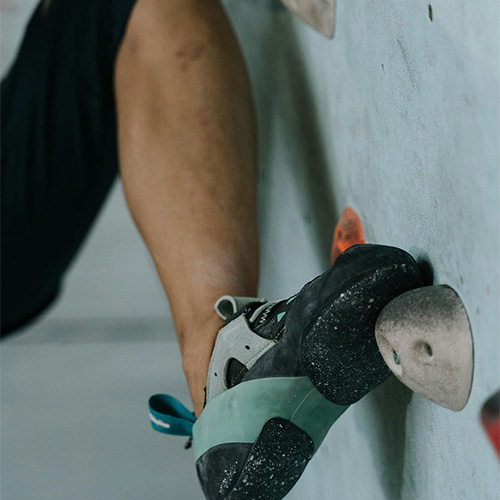
Edging means placing the rubber edge of your climbing shoe directly onto a foothold. You can use the inside edge, supported by your big toe for extra stability on small holds, or the outside edge, depending on the direction you need to move.
Smearing is used when no distinct foothold exists. Instead, you press the sole of your shoe against the rock, relying on rubber friction to stay in place. This is especially useful on low-angle slab routes with few defined foot placements.
When smearing, look for tiny ridges, dents, or rough patches to boost grip. You can also flatten your foot slightly to increase contact with the surface.
Keep these footwork rules in mind:
- Position your feet directly beneath your body for stable balance.
- Search for footholds just as carefully as handholds, if not more.
- Once your foot is set, avoid shifting it—this maintains stability for your next move.
- Keep your heel low to maximize rubber contact. A raised heel reduces friction and makes it easier to slip off the wall.
Maintaining Balance: Control Your Body on the Wall
Climbing feels easy when holds line up straight above you. But on technical routes that require side pulls and cross-body movements, balance becomes critical.
When reaching for a hold to the side, you can’t simply pull downward. You must counteract that sideways force to avoid swinging away from the wall—a common mistake known as “barndooring.”
Use these balance strategies:
- Press your foot in the opposite direction of the pull to create counter-pressure.
- Use your opposite hand or a hooked foot to pull against the movement.
- Lean your body weight in the opposing direction to act as a counterbalance.
Climbing Efficiently: Save Energy, Climb Longer
Learn to climb with less effort and give your muscles much-needed breaks:
- Keep your arms straight. Straight arms let your bones support your weight, not your muscles. Even a small bend in your elbow forces muscles to work constantly.
- Adjust your hips. Beginners often face their hips directly toward the wall, which pushes weight outward and strains the arms. Instead, press one hip close to the rock. This places your weight over your feet and lets you lean back comfortably with straight arms.
- A hip close to the wall also brings your shoulder nearer, improving your grip angle and reducing the chance of slipping.
- Climb with your eyes. Constantly scan the wall for rest positions, not just the next hold. Don’t limit your focus to chalked holds alone.
- When you find a good rest, use it. Let your heart rate slow down and shake out tight forearms to avoid premature fatigue.
A wide repertoire of climbing moves will help you solve complex sequences and take on harder routes. Every advanced technique builds on the basic movement principles covered above.